
The Hellish Views Scoring System - An Expanded Explanation
A follow-up post.

I have explained my scoring system a few times before, but only once in detail in my Preamble. I won’t be saying too much here that I haven’t already said there, but I will be pinning this post on my homepage for easy access (though don’t forget, I have a dedicated Contents Page).
I want to make it clear, I’m super keen on getting you all in on this! Whenever I post a scored film, I wanna hear yours too! Some of you have got the ball rolling, but let’s see how far we can go with it. Let’s gun for comment sections full of scores.
Anyway, first off, let’s start with the essential element - the table.
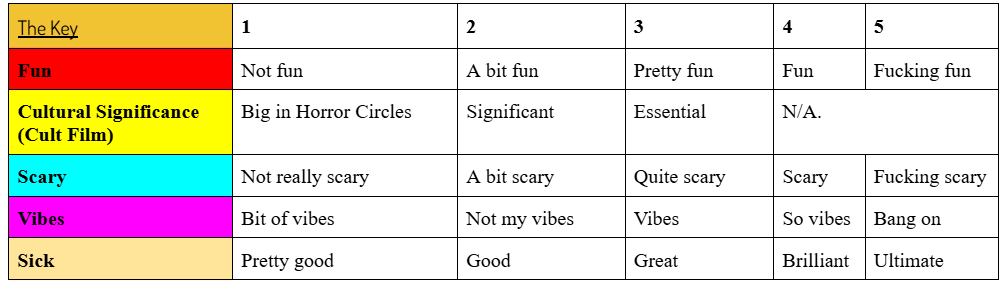
There are 5 distinct categories, and the high score is 23. This is the simple baseline that my system is based on.
What I’ll do here is touch on each category individually, then run through a few example scores from my existing posts.
Starting off with Fun - this is one of the simplest categories. Films that are camp, are objectively silly, or just have a good sense of humour score well here.
Next up is Cultural Significance. For this, I’ll break down each potential score.
If a film is Big in Horror Circles, it means that horror fans know and love it, but beyond that it’s obscure or seldom mentioned.
If a film is Significant, it’s known outside the horror genre, but perhaps not widely watched or appreciated.
If a film is Essential, it’s a classic - something like The Wicker Man (1973) or Scream (1996). It is a horror touchstone.
Following this, Scary is another simple one. Did a film make your skin crawl? Did you make your dog jump with your shrieking? Did you get in trouble for watching it at an inappropriate age (or did you sneak it into a highschool sleepover)? Basic stuff.
Vibes is a trickier element. My go-to example for a film that scores high on vibes is Suspiria (1977). Argento’s movie knows what it is going for - it is utterly unique and relentlessly weird. Two modern masters of vibes might be Robert Eggers and Ari Aster. Often you come away from their films emotionally and sensorily flashbanged. Many of their pictures have a clear aesthetic and feel in mind.
Last but not least, Sick is another basic concept. If you’re out there grinning devilishly, perched on the edge of your seat, and ready to hit replay straight after the film ends, it’s certifiably sick.
Now I’ve explained each category in more detail, let me introduce a new factor.
A low score does not mean a bad film.
How does that work? Well, bear with me. Below is the score for The Long Walk (2025)
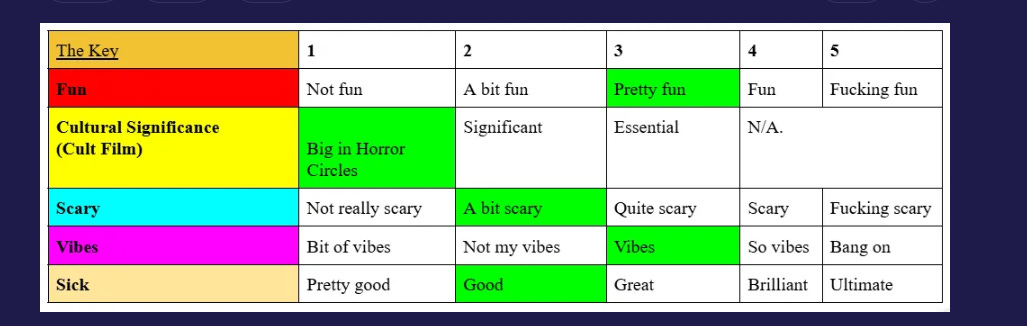
Total Score: 11/23.
The Long Walk is genuinely a solid movie. It is horrid, it is interesting, it has some great performances. However, for me, it didn’t hold a candle to the source material, and, as someone who revels in onscreen violence, I wasn’t as terrified by all the murder as someone else might’ve been. So, for these reasons, it scores low. Does that mean I didn’t enjoy it - quite the contrary, I thought it was pretty good, but even so, I wasn’t afraid or especially excited watching.
Let me now provide a hypothetical:
A new horror comes out, and it is a grisly gorefest that packs a serious emotional punch. However, the tension and nastiness leave no room for light-hearted moments, and the lack thereof puts off your average moviegoer. This film would score, let’s say, 16. It suffered in Fun and Cult Significance, but maxed out on Scary and Sick.
I’m hoping these two examples cleared up any confusion you might’ve had. If not feel free to get FAQs going in the comments!
And as ever, thank you for reading,
Until next time,
H.E.
What I genuinely love about this is that a good film can score poorly and a terrible film could score highly. I’d agree with Long Walk scores poorly on the system but is also better than an 11/23.
Not enough chaos on substack.
What I love about this is that it’s structured, but still with loads of room for subjectivity. You can assess ‘fun’ either by humour, and cleverness, and silliness, or by how much you enjoyed watching something. Same for sick, and scary. It’s structured but flexible. Anyway I won’t share mine because, as you know, I have a whole spreadsheet.