
BBC Ghost Stories For Christmas #2 - The Stalls of Barchester (1971)
'When the wind blows high In a night of February.'

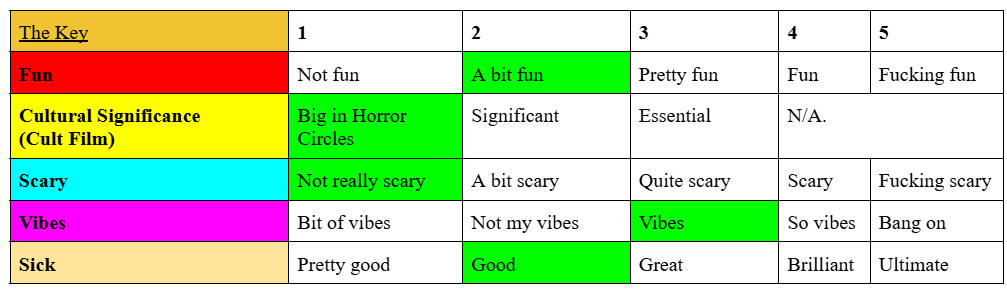
Total Score: 9/23.
I feel harsh giving this film a nine out of twenty-three, but the fact is, despite it being super atmospheric, capturing the M.R James vibe excellently, and being beautifully filmed, it isn’t very exciting. It has few and mild scares, and is more of a traditional ghost story. It certainly achieves everything it sets out to do, and is a pretty fun watch.
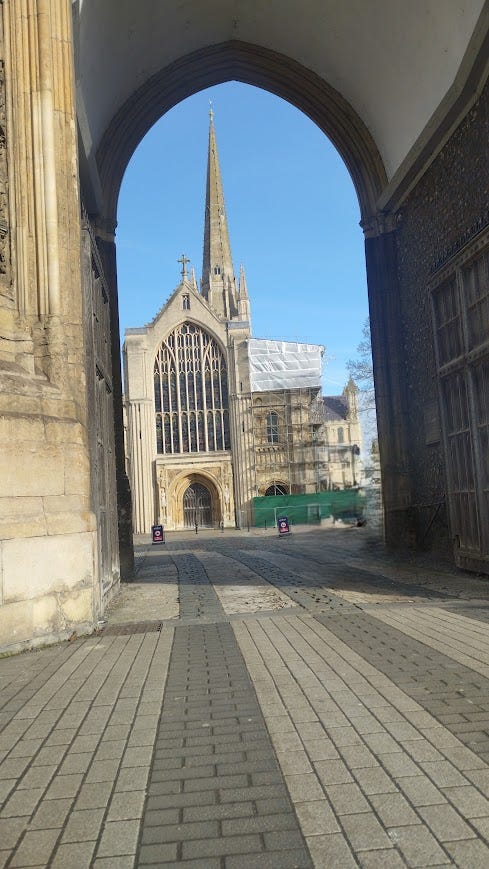
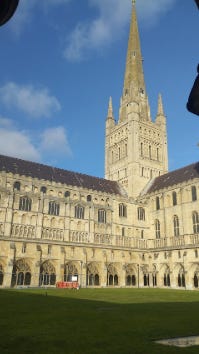
This is the first Lawrence Gordon Clark Ghost Story For Christmas, released in 1971. Much of it was filmed at the beautiful Norwich Cathedral, which I visited earlier this year and recreated the shot from the title card (among some other shots from later films).
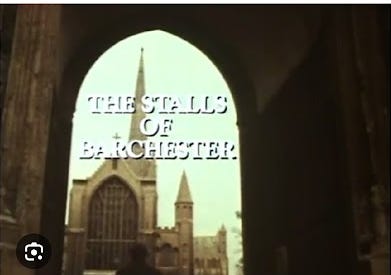
Initially the plot follows Dr Black, a 1930’s man cataloguing the archives of Barchester Cathedral. He discovers a mysterious file about a John Benwell Haynes, a previous archdeacon of the cathedral. With the frame set up, we jump back to 1872.
Haynes, played wonderfully by Robert Hardy, is keen to take the role of archdeacon. The current archdeacon Pulteney is very elderly, but seemingly shows no signs of ill health. Haynes’ stony resignation as his colleague continues to exist beyond expectations is deeply amusing, and almost puts one in mind of Basil Fawlty.
Anyway, at age 92 the ancient archdeacon pitches headfirst down his oaken stairs and dies. Hayne’s sister notes that our protagonist had commented on the slipperiness of the wood before, which he flat out denies. We are all but told he murdered the bloke, though, but in the world of the story the maid takes the fall (so to speak).
Hilariously, Haynes gives his sister a good telling off for speculating on who might replace Pulteney. Truly he is insufferable, and it is great fun to watch his stiff-lippedness.
Soon, Haynes is indeed made archdeacon. During a choral service he peers nervously at the maid, which is excellent plot-building. We get a strong sense of bribery, which is later confirmed. It’s conservative but clever storytelling.
After a while his sister pops to Brighton, leaving him alone. Who can blame her, given how bland and righteous he acts. The story introduces more narration from Haynes’ diary entries, which become increasingly erratic. These begin twenty minutes in, where he admits ‘I hear voices’, and feels company present where there is none.
Later, in the cathedral, a carving on the arm of the archdeacon’s stall transforms beneath Haynes’ hand, turning from the familiar smoothness of polished wood to the wiry fur of a black cat! Oh dear me. Something strange is afoot, and our clergyman knows it. He investigates the building’s carvings further, and there is some discussion about them. There are the angels, and then there is, of course, the damned, ‘everlastingly burning, sir, as is their lot’. The character who delivers this line - some priestly underling - is great fun to watch throughout, even if he doesn’t do much. We discover, significantly, that the carvings are almost all 14th century, bar the arms of the stall, which are more recent, and made from oak from the nearby Holywood.
In the Holywood with a local expert it is revealed the carvings were done by John Austin ‘the twice born’, a man with ‘second sight’. Yikes. But that’s not all! Oh no. The wood used was from trees central to pagan rites. These rituals happened within living memory. One such tree, the Hanging Oak, is mentioned as having had bones interred beneath it, and charms hung from it.
The film continues to use the ringing of church bells to generate an eerie vibe, and it doubles to signify Haynes’ overwhelming anxieties.
Much like in Whistle and I’ll Come To You there are long stretches of silence in this film where very little happens. It’s all building tension. There are occasional noises in the shadows where nothing walks, and then total quiet. Mostly there is only a man slipping deeper into the fear that he might be losing his mind.
In the dark, Haynes is scared shitless by a cat that appears suddenly on the stairs. Later, whilst the choir sings about the punishment of the damned, he looks down to find a great robed skull under his hand. He is visibly appalled, but manages to keep quiet.
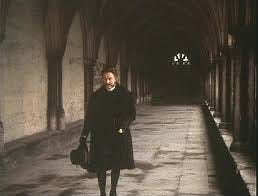
Following this second, and final change of the eponymous Barchester stalls we get the strongest scene of the film. The archdeacon wanders the long halls of the cathedral in the dark - which in Britain, in January, could be as early as 4pm. Regardless, there’s only dim candlelight. As he walks, a second set of footsteps seem to echo behind him. Then he stops, and the sound continues. But there is no one there.
Suddenly he’s startled by the ‘everlastingly burning’ fella, who also thought he heard someone, and even goes to check, despite Haynes firmly telling him they are alone. This scene is super creepy - the sound of walking on stone in a huge space like the corridors of Norfolk Cathedral cannot be understated.
Later, we learn that Hayne’s cousin briefly visits, and spots the ghostly cat. Our man is perturbed, but not as much as he is when someone asks to come in on a cold winter’s night. Initially he thinks nothing of it, but when the door opens, just a tiny bit, and then it stays just that little bit open, he leaps up like he’s sat on a pin. As he bounds through the door he catches a slight glimpse of what might have been a figure going around the corner. But there is no one.
He enquires about the cat to a servant, who confirms there has never been a cat, to his knowledge. Soon after a cat yowls in the night. He goes to search, pupils dilated and eyes covered in a sheen of terror. A hiss comes from the dark, but the cat is nowhere to be seen. He treads carefully up the stairs, from where the noises came, but then the cat is at the bottom. He spots it, but then turns to continue going upstairs, and above him looms a hooded figure, face obscured in blackness. It scratches his cheek vilely and he collapses down the stairs, breaking his neck in the process. We later learn he sustains injuries that leave him unrecognisable - in the original text, it’s noted that his ‘eyes, nose and mouth’ are marred, as if by some beast. Horrifying stuff, which I wish we got more of in the film. This scene is very atmospheric, but lacks James’ bite.
Back in 1931, in a coda, the archdeacon’s stall seems to have been recently restored. There is no trace of the carvings. However, a local museum curator (who plays a colonel in Whistle and I’ll Come To You) shares some notes on the figures. As it turns out, one of the carvings was split in half accidentally, and a charm of sorts was found inside. It cast a terrible spell on anyone who touched the wood after having committed an act of violence. The man who found this poem burnt the carvings, and we are left wondering what terrible fate might befall him.
This wraps the plot up nicely, in a way that any fan of the traditional Victorian ghost story would enjoy. A nice concise explanation, and a slightly spooky twinge at the very end. The violent death of one or more of our characters is something you can rely on in a lot of M.R James stories - and you don’t always see it coming like you do in this, either.
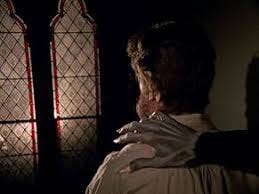
Overall, The Stalls of Barchester is a decent start to an excellent series of seventies TV movies. It is a good ghost story adaptation in atmosphere and tone, and is well-performed and beautifully made across the board. It isn’t my favourite, but it is still worth the watch if you’re enthusiastic about ghost stories. It also touches on British folk tradition in a fascinating, if brief, manner, which is always fun!
As ever, thanks for reading,
Until next time, where we’ll be watching A Warning To The Curious (1972) - a personal favourite of mine,
H.E.
I rather like this type of ghost story. All atmosphere and little action. Creepy.
Great write-up! It's so cool you got to visit the filming location, too! It looks gorgeous!